
By Sister Jeannie Masterson
When I entered the convent 55 years ago at the age of 18, I assumed that I would teach elementary school in Cincinnati all my life. The furthest thing from my mind was that I would travel to Japan! Yet, in the past 9 years as a part of the Congregation Leadership Team (CLT), I have been to Japan 17 times – in fact, I’m in Japan as you read this! The delights are many, from coming to know our Japanese sisters to being introduced to an entirely different culture.
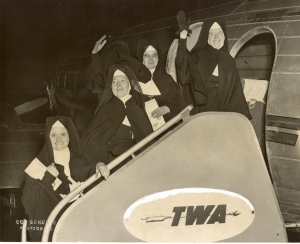
Our sisters have always gone where they are needed,
and in 1950, they went to Kyoto!
When in Japan, I am constantly challenged to open my mind and my heart to another way of thinking, speaking, living. I’ve learned how instinctively I assume that “my way” is the ONLY way, and how often I am dead wrong about that. I am by nature direct in my communication; Japanese are circular. I expect immediate decisions; Japanese need to mull thoughts over time. I think in terms of what I want; Japanese hardly have vocabulary for “I” as they focus on “we”. I have food preferences because of familiarity, for which there are no comparable options in the Japanese cuisine. I expect traffic delays, whether on the highway or at the airport; Japanese are extremely punctual and reliable – as a matter of fact, should a taxi not be at least 5 minutes early, the passenger will receive a phoned apology and a new arrival time!
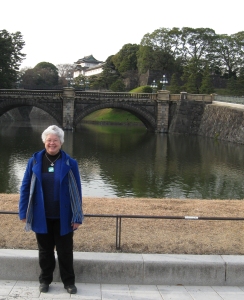
I’m not sure where I was heading in this picture,
but I know I got there on time!
While in Japan, I find myself listening differently now than I did on my first visit: what’s beneath the words? What are the words for which our meanings are totally different without our realizing it? Where are the hidden assumptions, on both sides – those beliefs that are so ingrained that neither of us ever thinks to say out loud? How do I comprehend and appreciate those assumptions that refuse clear translation, when I’m never there for more than ten days?

We may have words with different meanings,
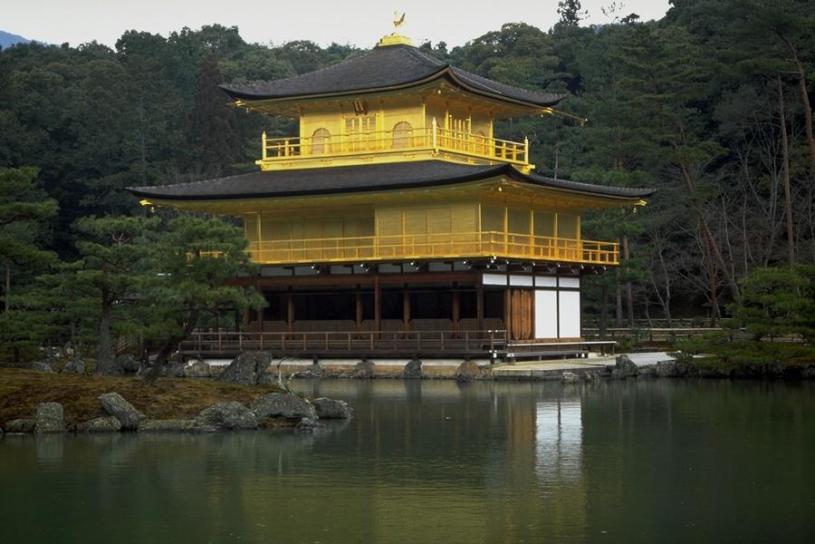
but we all agree that this building is beautiful!
The central value of the Congregation of St. Joseph is unity – Jesus prayed “that all may be one”. These exposures to Japanese culture invite me to pray more deeply to understand what “unity” means: surely it doesn’t mean blending so that neither culture is maintained. It brings me to the realization that our world contains hundreds of cultures, each unique and developed and cherished. How do I cultivate true respect for each, neither imposing my ways on them, nor fearing their influence on me? How can I continually be conscious of, and appreciate, their multiple gifts to the totality of the world?
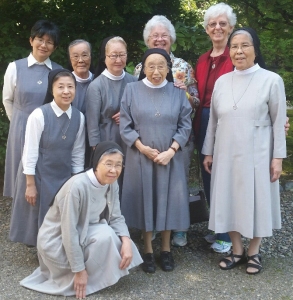
We are all one! Whether from Japan,
the United States, or anywhere else in the world!
Going to Japan calls me to think global, to open myself to new understandings, to acknowledge that we Americans are not the center of the universe. We are part of a whole, and the more we work to bring the whole together – rather than divide it – the more amazing that whole will be.
In 1950, the Bishop of the Diocese of Wichita asked Sisters from our founding community of Wichita to establish a clinic for the poor in the Diocese of Kyoto, Japan. Since our first sisters arrived, our congregation has ministered to those in need through engaging in healthcare, senior care, education, and retreat ministries in Japan. Sisters from our Congregational Leadership Team visit our sisters in Kyoto and Matsusaka twice a year.
About the Author
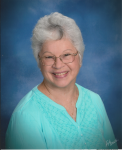 Sister Jeannie Masterson is currently serving her second term on the Congregation Leadership Team. Earlier she served in provincial leadership, teaching, high school administration, and as a pastoral associate for adult formation. Sister Jeannie was the founding and active director for eight years of Cincinnati’s Jordan Center, which brought health attention to uninsured working people and their families.
 Beyond the Habit