
Image

And Jesus said, “Will you be my Valentine?”

By Sister Judith Minear

Valentine’s Day!

As a child, Valentine’s Day was my favorite holiday of the year. My classmates and I made beautiful boxes to contain our treasured cards, and it was understood from our teacher that nobody was to be left out. It was a day filled with joy and laughter, hidden surprises and tender messages. It was a day when Love could shine! And, at the end of the day, there was a classroom party with delicious cupcakes served by smiling moms. Sigh. What was not to love?

valentines-day-1565981_1920

As I grew older, I began to understand the lavish commercialism and complicated expectations that surround Valentine’s Day, and my “favorite holiday” lost its sparkle. I began to appreciate how complicated Love is, and that its scope of emotions ranges from unbridled joy to despair and sorrow. I learned from poets and artists that Life (and Love) presents itself as wells of chaos, and our human mission is to work through the chaos to discover the essential nugget at its core…which, in my experience, is always Love.

love-heart-romantic-gift

I was truly saddened to lose the exhilaration of my child-heart’s view of this holiday. What I did not lose, through grace, was the idea that beautiful, hidden treasures are all around us, that Love trumps everything, and that nobody is to be left out.

This year, Valentine’s Day falls on a sacred day in the Christian calendar: Ash Wednesday. In the first reading from today’s Eucharistic liturgy, God cries out, “turn to me with your whole heart.” Whole-hearted intention is one of the great gifts of Jesus to us. We learn from Jesus to anchor our lives in God’s love, seeking always the highest moral freedom and the most perfect, inclusive Love we can achieve, each and every day. Of course, we humans fall and fail, over and over. But on our best days our higher selves continue to reach toward living a life with real purpose, just as Jesus did.

giphy (69)Each year, Lent is an opportunity to grow our love…to work on our relationship with the Holy One just as we must work on our relationships with every person in our lives who holds a piece of our heart. One way I do this is by asking myself questions. What habits in my life stand in the way of being the loving Presence God invites me to be in the world? What practice might I be called to that will help to open me to Love, rather than blocking me from noticing others around me who may be lacking Love?pexels-photo-433495One of my favorite writers/poets, Jan Richardson, speaks of Sojourner Truth in her reflection “Upon the Ashes.” Sojourner, a fiery abolitionist, orator, and preacher knew she was called by God to speak the truth about slavery. Ms. Richardson writes, “One day, while preparing for a speech at the town-house in Angola, Indiana, she heard that someone had threatened to burn down the building if she spoke there. ‘Then I will speak upon the ashes,’ Sojourner replied.”heart-1841781_1920Ashes can remind us of the horrible things we humans have done to one another: burning down the homes or cities of our “enemies,” setting crosses on fire because of skin color, and even reducing bodies to ashes in war or domestic disputes. Many of these crimes against Love claim to be committed in the name of religion, but Jesus’ life shows us another way. Always one to stand with the poor, the marginalized, with every neighbor without distinction, Jesus teaches us to “speak upon the ashes” of our neighborhoods and our world and, in moving among them, to coax Love to grow, to flourish, to thrive.

giphy (72)

May Ash Wednesday remind us that our very bodies are made of dirt, dust and earth, and that someday, we will return to this very state. May Valentine’s Day awaken us more deeply to God, who created us and who calls us to Love in the world. Not a perfect love, because we will fall, again and again…but with God’s help, we will continue to “stand upon the ashes” and speak God’s truth: that we must love every sort of neighbor without distinction. Nobody is to be left out.

The Lover of All Hearts says to each of us today:
“Will you be my valentine?” *

How will you respond to this question?

I respond humbly, gratefully:
“Jesus, You know everything.
You know I want to be your Valentine” *

greeting-card-edited

*Joyce Rupp, “Will You Be My Valentine.” 

About the Author

16-judyminear-copy
Sister Judith Minear currently serves as part of the 3-member team for CSJ Ministries as Coordinator for Mission Integration, working with our 26 sponsored ministries. In her free time, she loves drawing zentangles, stalking birds and savoring poetry.



Image

A Quiet Revival

By Sister Marcella Clancy

“All Sisters are expected to belong to a Renewed Local Community.”

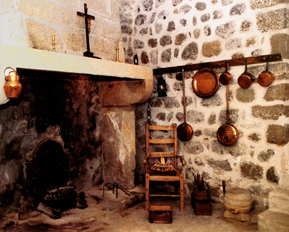
In 2007, one of the practices begun by our first sisters in 1650 LePuy, France was revived among us. We were encouraged, urged, “expected” to gather ourselves in groups of between 6 and 10 sisters who would come together monthly for “sharing of the heart” and the “order of the house” during what we call Renewed Local Community or RLC.

LePuyKitchen.jpgThe kitchen in LePuy, France, where our first sisters gathered to share their hearts.

Having participated in this practice for over 10 years now, I have come to deeply appreciate the wisdom of the Spirit who moved us in this direction. This is a sacred monthly event. Like most sacred events, it is embedded in the very commonplace “stuff” of our everyday lives. We are ordinary women who, like you, experience the loss of family members and dear friends, are pained by the brokenness of those we love, profoundly impacted by the fragility, suffering and joy of those to whom and with whom we ministry, and struggle ourselves, constantly, to be attentive and faithful to God, who is often elusive and always mysteriously beyond our grasp.

heart-3117389_1920

RLCs are not business meetings. In fact they are not meetings at all, but rather times of cherished personal communication. Our documents state, “RLCs are a place where courageous, loving, meaningful, celebrative, and intimate conversations take place.” I find it relatively easy to chat on about selected events and activities that have occurred in my life over the last month and with my Irish sense of humor could make it all very entertaining — but that’s not the point. The point is to share where I have recognized, been confronted, or awed by God’s presence in my daily routine of living or… perhaps not found God at all. This is not a place or space where we try to impress one another with our holiness, but rather honestly and transparently “share our heart,” with its struggles, failures, doubts, fears, hopes, joys, and efforts to be brave, to love and to be faithful all within the context of our most ordinary lives. Obviously prayerful reflection, vulnerability, reverence and confidentiality are requisite components of this kind of sharing.

So that’s the “sharing of the heart” but what’s this thing called “order of the house”? It is a strange term and it took us a while to get a grasp on it ourselves. After each woman has shared, we take time to reflect quietly about the common thread we heard in our sharing. Where is the Spirit moving in us as a community, what is the Spirit asking of us, where is the Spirit drawing us? Amazingly there is always a common thread. The Spirit works in us and through us individually, but also as a community. It is in this practice we begin to discern the subtle movement of the Spirit.

house-insurance-419058_1920

So you might be thinking, “What’s the purpose or goal of the RLC? What do you accomplish? Couldn’t you use your time more profitably?” These are good questions, and some of us have asked ourselves these very questions as well. There isn’t any goal. We accomplish nothing. We are unprofitable servants. Sometimes the sharing is wonderful and I want to take off my shoes because I recognize I am on holy ground. And sometimes…not so much. Yet what is significant is the accumulative effect. Without deliberately trying, slowly a profound bond develops, a deep sense of awe develops of how uniquely God works in each of us, and a treasuring of each woman for her sheer goodness grows in our hearts.

Because of the quiet and hidden transforming experience of the RLCs, unwittingly, the sharing of the heart and order of the house has been integrated into all our more formal gatherings as well. Some associates, who are lay men and women who share in the Sisters of St. Joseph’s beliefs, belong to RLCs, and some have formed their own circles. It has become the essential practice in how we become attentive to where the Spirit is leading us as a Congregation.

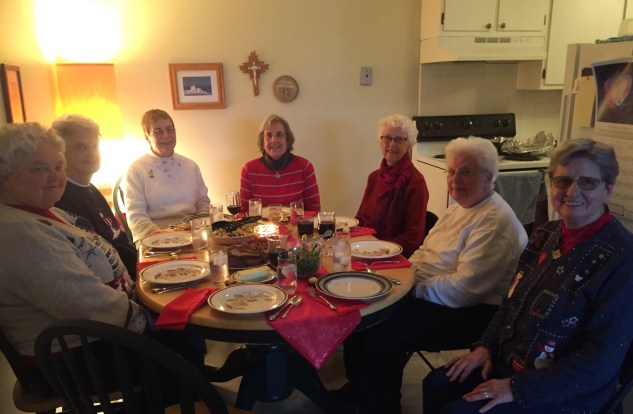
RLC Christmas 2017 croppedA meeting of my RLC this winter.

So what’s the point of this blog? Just to impress you? NO! Not at all! In our culture, with all its divisions, with all our constant chatter, with all the many instantaneous ways available to us to communicate, and with often the meanness of social media, we offer an alternate way to communicate. One that is deeply personal, wonderfully healing, and profoundly hope filled. These kinds of small communities with this kind of intimate sharing can exist between spouses, within families, among friends, and even with co-workers. Start your own RLC! Let me know how it works out and find out how deeply you are REVIVED!

About the Author:

marcella
Sister Marcella Clancy currently lives in the Detroit area. She offers spiritual direction, serves on Congregational committees, and companions one of our newer members. She loves long walks, good movies, and leisurely lunches with friends.


Image

The Building Blocks of Community

 By Sister Sallie Latkovich

Laying the groundwork. Putting down the foundation. Paving the way. Whether it’s for an actual building, a project, or a committee, these sayings are often used to point towards the start of something. I believe we often use metaphors for building because they are such visual representations of what we aim for: new structure.

Building a wall for structureWhat is the “stuff” or our building?

So, what are the “building blocks” for community life as a Sister in the Congregation of St. Joseph? I’d like to explore three of these building blocks, which are the very foundation of the strong relationships we share: our stories, our vision, and our commitment.

OUR SHARED STORIES

We, the Congregation of St. Joseph, share many stories. Some of these stories we also share with the wider world, starting with the story of our Earth, created by God, which nurtures all of life and our lives. We also share our Judeo-Christian heritage of both the Hebrew and Christian Scriptures, with which we ponder and pray. We share being baptized into Christ, and members of the people-of-God Church.

earth-1990298_1920We all share the stories of our Earth

As sisters, we also share our CSJ history and charism, from our founding in 1650 in LePuy, France. We embrace the stories of our earliest Sisters there, and those who set out for St. Louis in 1836. We love to hear the stories of the Sisters being called to other dioceses around the United States. For example, Mother St. George Bradley came to establish the Cleveland foundation, having been in St. Paul, as a province of St. Louis.

The story goes that the St. Louis Sisters had become urbanized while St. Paul remained quite rural. Mother St. George couldn’t accept the new constitution of the St. Louis Sisters, and left St. Paul with all of the money and all of the novices! Mother St. George and her little band stayed in Erie for a short time, until she was invited to the diocese of Cleveland in 1872.

P croppedSisters with one of our buildings in Cleveland
In 1898, Mother Theresa Fitzmaurice purchased property on the far west side of Cleveland where two buildings were constructed: a motherhouse and a boarding school for boys and girls. It was in 1905 that a large motherhouse was built and in 1929, St. Joseph Academy was built. Various repairs and additions came about; and even now, restoration is taking place.

Along with the buildings, we still revere some of the earliest writings of the Congregation, which came to be called the Congregation of the Great Love of God! These include, among other things, the Maxims, and our early Constitution.

Maxim-4

We certainly share the stories of our mission and our ministries. These include schools where we have taught, parishes where we have served, and more recently, various services to the “dear neighbor” addressing the needs that have risen up such as immigration, sex-trafficking, direct service to the poor, gun control, etc.

To be short, it has been our shared experiences and stories such as these that bind us together as one.

OUR SHARED VISION

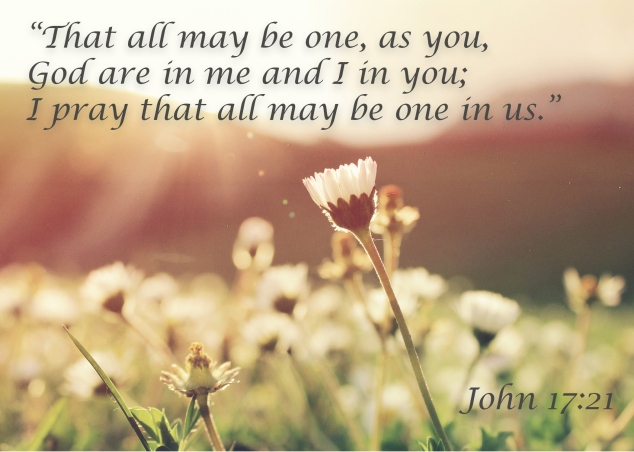
Our shared vision answers the question of “what do we see?” We see a world of oneness, the same world for which Jesus prayed: “That all may be one.” Thus, we see our mission as one of reconciling, unifying love in a world so in need of it.

That All May Be One

OUR SHARED COMMITMENT

Recognizing that we are called to incarnate our mission and charism in our world in fidelity to God’s call in the Gospel, the Congregation of St. Joseph commits ourselves to four Generous Promises:

–we promise to take the risk to surrender our lives and resources to work for specific systemic change in collaboration with others so that the hungers of the world might be fed.

–we promise to recognize the reality that Earth is dying, to claim our oneness with Earth, and to take stopes to strengthen, heal and renew the face of Earth.

–we promise to network with others across the world to bring about a shift in the global culture from institutionalized power and privilege to a culture of inclusivity and mutuality.

–we promise to be mutually responsible and accountable for leadership in the congregation.

community heart

The call heard by St. Francis of Assisi from God was: “rebuild my Church.” We members of the Congregation of St. Joseph are busy rebuilding not only our brick and mortar structures, but rebuilding the community which gives us life, and gives life to the world!

About the Author

sallie-sized-for-use
Sister Sallie Latkovich directs the Bible Study and Travel Program as well as the Summer Institute at Catholic Theological Union in Chicago. As a member of the Bible Department, she teaches Biblical Foundations of Spirituality and The Bible For Ministry. She enjoys music, plays, and movies; and loves visiting family and friends.


Image

For Auld Lang Syne

Should auld acquaintance be forgot
And never brought to mind
Should auld acquaintance be forgot
And auld lang syne

For auld lang syne my dear
For auld lang syne
We’ll take a cup of kindness yet
For auld lang syne

Auld Lang Syne is one of the most recognizable songs in the world. It is sung at funerals, celebrations and as an announcement that closing time is approaching in Japanese department stores.

pexels-photo-191414

But I wonder if you were among the many who sang Auld Lang Syne and are still singing this heart filling song during this time of the New Year?

Credited to the Scottish poet Robert Burns, the words in the title of this are translated “time gone by” , “old times sake” , “for the sake of old times”.

giphy (64).gif

In the movie When Harry Met Sally, Harry asks Sally, “What does auld lang syne mean, anyway?” And Sally responds, “It’s about old friends.”

giphy (67).gif

Perhaps the invitation for this new year is to think in a new way about this calendar year. Let’s not make resolutions, let’s keep remembering the good in the world, in our lives, in our families, in our neighborhoods, in our communities, in our country, for old friends.

Processed with VSCO with e5 preset

Let’s drink a cup of kindness to:

  • Our children
  • Earth
  • Immigrants and refugees
  • Parents
  • Politicians
  • First responders
  • Health care providers
  • Teenagers
  • Enemies
  • Artists

You might just want to add to this possible list of kindness cups for auld lang syne.

pf-3046160_1920Happy New Year – Let us be kind.


About the Author

Sr. Carol photo edited
Sister Carol Crepeau, CSJ ministers as a facilitator and leader of group dynamics for non-profits. Guiding the annual Congregation of St Joseph Pilgrimage to LePuy and Lyon, France is one of the most wonderful activities of her life. She also enjoys a good book and gathering with friends for prayer and conversation.


Image

What the Sisters and Elf Taught Me About Christmas

Elf is one of my favorite Christmas movies. While I’m not always a big fan of the Christmas season, this Will Ferrell movie about Buddy, a human raised by elves, who must go to New York to find his biological father, can always make me laugh and get in the holiday spirit.

giphy (54).gif
When I tell people I’m not a big fan of Christmas

This year, as I watched the film, a cup of hot coco in my hand, I couldn’t help but notice that many of the holiday themes that play throughout this lighthearted film are the same themes I see reflected every day by the sisters I interact with at work, especially around the holidays. And so, for some lighthearted Christmas fun, I offer you 4 ways that Sisters of St. Joseph are like Buddy the Elf.

1. The best way to spread Christmas cheer is singing loud for all to hear

giphy-downsized-large (1)

Okay, this first one might be the most obvious, but Sisters have Christmas spirit in spades! Our centers have been decorated in Christmas cheer for weeks, giant trees, beautiful nativity sets, and twinkle lights lining every hallway. Even as someone who can sometimes be a Scrooge, encountering the sisters and all their Christmas cheer puts me in the holiday spirit very much in the same way that Buddy’s insistent Christmas singing and holiday cheer bring a smile to my face.

Old Entryway

2. There’s room for everyone on the nice list

giphy (49).gif

One of the three rules of the elves is that there’s room for everyone on the nice list. In fact, Buddy finds out his biological father is on the naughty list and knows he has to do something to help bring him around to the nice side. Similarly, the sisters love the dear neighbor, without distinction. They seek to bring all people together as one with God, and all creation. No matter our pasts, no matter our circumstances in life, there is always room for us.

3. Christmas Spirit is about believing, not seeing

giphy (61).gif

For many, this season has become about the commercialized idea of Christmas. I know, for me, that’s one of the reasons I struggle with the holiday. Rushing around to buy presents, bake cookies, and get pictures with Santa can make us forget what Christmas is really about. At one point in the film, Santa’s sleigh won’t fly, because not enough people believe in the magic of christmas.  Buddy’s brother asks Santa why he doesn’t just show himself to the crowd of people in New York. After all, if people see Santa, they’ll have to believe in him, right? But, Santa says, Christmas is about believing, not seeing. It’s about having faith.

Advent

Advent is a season of faith. A season of anticipation and belief in the coming of something bigger than ourselves, even though it is something we can’t tangibly see. Understanding that the season of Advent is about faith, hope and belief, not about shopping, is something that the sisters have really helped me understand this Christmas. Check out the sisters weekly Advent reflections to see what I mean.

4. It’s all about love

giphy (50).gif

So what saves Christmas in the movie? What makes Santa’s sleigh fly and allows Buddy’s father to shun commercialism and return to the nice list? Love. At the end, the heart of the movie is love, and realizing that our love for others is what matters. Of course, the sisters exude love in all they do. Love for each other, love for the dear neighbor, love for the world. By choosing to act out of love, the sisters, and Buddy, have reminded me that what really matters are the relationships we make, with our loved ones, with each other, and with God. When we celebrate Jesus’s birth on Christmas, we’re celebrating the ultimate gift of love to the world.

I hope your Christmas is filled with love, hope, and Christmas spirit. And of course, plenty of smiles.

giphy (51).gif

About the Author

Elizabeth-Powers,-WebElizabeth Powers is the Electronic Communications Manager for the Congregation of St. Joseph and manages the blog, Beyond the Habit. She sometimes acts as a contributing writer. She loves reading, writing, Harry Potter, and PBS. This year, she’s working on loving Christmas.

Image

So This is Christmas: Finding Joy in the Darkness


It’s beginning to look a lot like Christmas, everywhere you go.

We’re told it’s the most wonderful time of the year. A time when hope and love and faith shines brightly from every corner. After all, everybody knows a turkey and some mistletoe help make the season bright. And tree tops glisten and children listen to hear sleigh bells in the snow.

giphy (46)Everyone else, when they hear Christmas music.

Yes, if you listen to the songs that have been playing on every radio station, in every store around town, we’re all simply having a wonderful Christmas time. But what happens when Christmas does not bring with it the immediate joy the season is meant to invoke? This year especially, during a time that has felt tumultuous for our country and for our world, how can we simply put up a tree, string up the Christmas lights, and celebrate?

giphy (48)Me when I hear Christmas music.

For me, anyway, they’re singing deck the halls, but it’s not like Christmas at all. I keep asking myself questions as the winds get colder and the songs get merrier. So this is Christmas, and what have you done? Another year over, a new one just begun. What have I done this year that has made a difference? How can I find the beauty of Christmas in days that feel so gloomy?

But then I remember the stars are brightly shining; it is the night of our dear savior’s birth. Even in days that are filled with doubt and worry, Christmas will come, bringing joy to the world on a silent night.

winter-2894499_1920

Maybe you think this seems trite. Can the coming of Christ really do enough to lift our spirits? Can being reminded that a child is born change the course of our world? Maybe not. But isn’t that what Christmas is really all about? Having the faith that away in a manger a small child came to save us, even though the world is dark?

If anything, maybe we need Christmas this year more than ever. Maybe we need a little Christmas, right this very minute to help remind us that throughout the history of the world there has been darkness and tragedy and fear. But through it all, God’s light has always shined down upon us, and every year we celebrate, reminding ourselves that with the coming of Jesus, comes joy to the world.

pexels-photoWhile our troubles may not be out of sight, neither is hope. So, have yourself a merry little Christmas. 

 

About the Author

Elizabeth-Powers,-Web
Elizabeth Powers is the Electronic Communications Manager for the Congregation of St. Joseph and manages the blog, Beyond the Habit. She sometimes acts as a contributing writer. She loves reading, writing, Harry Potter, and PBS. This year, she’s working on loving Christmas.

Image

Living a Legacy of Love: Ministering to Those in Need

By Jennifer Berridge,
Candidate for Vowed Membership
with the Congregation of St. Joseph

In November of 2016, I began a new Ministry at St. John’s Home for Children. St. John’s is a licensed residential treatment center for boys ages 8-13. Opened in 1856 as an orphanage by Bishop Richard Whelan, the first Bishop of the Roman Catholic Diocese of Wheeling-Charleston, and the Sisters of St. Joseph, the St. John’s/St. Vincent’s Home for Children has been home to thousands of boys and girls over the past century and a half.

IMG_0149

Before working at St. John’s, I had never really worked with boys before. I mainly worked with young women as a mentor and companion. I thought to myself, ‘Really? Boys? What do I know about boys?!?’ Then I had a realization that yes, it may be true that I don’t know boys. But I do know love. The advice that I received from our sisters who were in ministry at St. John’s long before me is “Just love them.”

I thought to myself, ‘Really? Boys? What do I know about boys?!?’ Then I had a realization that yes, it may be true that I don’t know boys. But I do know love.

Now, I can honestly say that this has been the best ministry experience that I have ever had! Although it’s not without its challenges, of course. On days that are difficult, I ask myself ‘If not I, then who? Who will love my boys? Who will companion them during this very difficult time in their lives?’

This is not always easy, but I am called to do my best. I have to give back. Some days, I have to dig deep. I turn to the wellspring of love that I know is from God alone. I ask for the graces that are needed for the day ahead. And I pray for the grace to use my life as a blessing wherever I am.

Cassie Queen-Case Manager at St. John's at her desk in her office.

Myself and Cassie Queen, Case Manager at St. John’s.

I am humbled by all the love, support, and encouragement that I have been so freely given by all of the Sisters of Saint Joseph in my life. This is the power of community. I am blessed beyond all measure to be in a community of sisters who genuinely love me and care about me. None of us can do this alone, but together I believe that we are powerful. Together, we can try to forge a new world with a love that connects. I believe in the inherent goodness of the human heart. And I believe that every day, in a thousand different ways, people are acting redemptively in each other’s lives, even though sometimes we are not paying as much attention to this as we could.

St. John's Founders Day Mass

I enjoyed the St. John’s Founders Day Mass with sisters and friends.

Being new to religious life, everything feels like another new experience. It can feel like a whole new world, a whole new vocabulary, which sometimes I don’t understand. So I ask a lot of questions. It’s humbling to me to be carrying on this long legacy of love that was started by our sisters so long ago. I can honestly say that this has been a harvest time in my life, a grace-filled time in my life, like I have never known.

God promises us that all things are made new. “Therefore, if anyone is in Christ, they are a new Creation. The old has gone, the new has come. Behold, God make all things new.” (2 Corinthians 5:17) Now I am no Scripture scholar or nun expert! But I simply remind myself not to look at the challenges, focus on the fears, or walk down anxiety lane, even when I face difficulties at my job. I look solely to our Good and Gentle Shepherd. I fix my gaze on the face of Christ. In this brilliant light, things become clear. I look at God working through us all, always walking with us, and this gives me great hope.

About the Author

photo of jenniferJennifer Berridge is a current Candidate with the Congregation of St. Joseph. A native of Cleveland, OH, she currently lives with sisters from the congregation in Wheeling, WV and serves as a Youth Care Worker at St. John’s Home For Children. In her free time, Jennifer like to write, listen to audiobooks, watch movies, and visit with sisters.

Image

Foremothers in the Faith Inspire Movement for Female Deacons

By Sister Chris Schenk

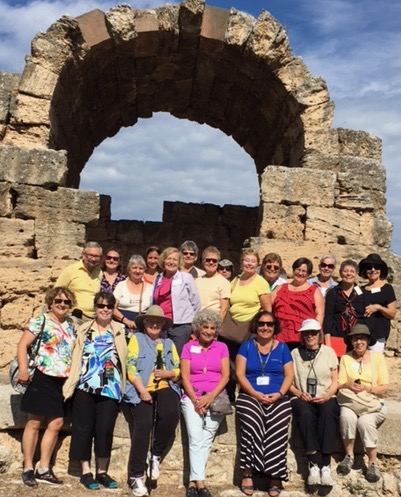
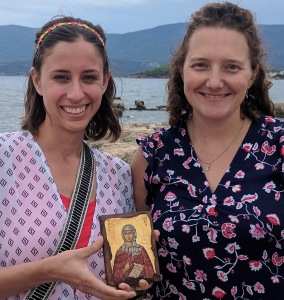
I recently had the great joy of serving as educational director for a “Foremothers in the Faith” pilgrimage to sites in Greece where early Christian women had founding leadership roles.

Most people are completely unaware that women helped establish many of the earliest churches in Greece, Turkey and Rome. This is because church tradition always credits their founding to Paul. Early Christ-followers circulated and preserved Paul’s undisputed letters (circa 51-62 A.D.) and later, Luke’s Acts of the Apostles (circa 80-90 A.D.), both of which chronicle Paul’s missionary journeys in considerable — if sometimes differing — detail.

st-paul-2176669_1920

Many think that Paul established many of the earliest churches in Greece, but women had founding roles, too!

So, it’s understandable that later Christ followers thought Paul did it all. But he didn’t. In fact, Paul himself credits Prisca and her husband Aquila as his “coworkers in Christ Jesus, who risked their necks” for him (Romans 16: 3-5). He also describes two women–Euodia and Syntyche of Philippi—as coworkers who “struggled beside me in the work of the gospel” (Philippians 4:3).

Acts identifies Lydia of Philippi as beginning the first house church in that city (Acts 16:6-40), and Paul’s letter to the Philippians suggests that a disagreement between two women, Euodia and Syntyche, is threatening the unity of the church there (Philippians 4:2-3). According to well-known New Testament scholar, Sacred Heart Sister Carolyn Osiek, Euodia and Syntyche were very likely among the episkopoi and diakonoi, or leaders in the church, to whom Paul addresses his letter.

Jocelyn and Jenny with Lydia photo

Jennie Mertens, left, and Jocelyn Collen hold an icon of Lydia of Philippi at the port of Cenchreae, hometown of Phoebe the diakonos in Romans 16:1-2.

In Thessaloniki and Berea, the Greek “leading women” supported Paul’s mission even as the male synagogue members ran him out of town (see Acts 17:1-15).

With 19 other “pilgrims” I visited archaeological ruins at Philippi, Thessaloniki, Corinth, Cenchreae, and Athens as well as assorted sites at Delphi, Meteora, and the lovely island of Aegina. My personal favorites were Corinth—where we honored the dynamic missionary duo Prisca and Aquila—and Cenchreae, where we held a prayer service honoring Phoebe, the leader of the church in that city (Romans 16:1-3).

Who were some of these women of Greece and what did they bring to the early church? Let’s explore the lives of two of them a bit more deeply to understand how they played a role in the church’s history, and could possibly impact the church’s future.

Prisca and Aquila’s house church at Corinth
Prisca and Aquila arrived in Corinth some nine years before Paul, and had already established a thriving tent making business when Paul came to the city. Tents and awnings were in great demand because every two years the Isthmian games, a festival of athletic and musical competitions, were held nearby. It is likely that the couple had also established an early Christian community that met in their “house church” (see photo). Here early Eucharistic meals were held and both Prisca and Aquila probably presided, as was customary at the time.

Corinth.jpg

Pilgrims group in front of restored two-story structure at Corinth. It served as both a commercial establishment and a family dwelling and is probably quite similar to Prisca and Aquila’s tentmaker’s shop and “house church” in that city.

Paul first used their home as a base of operations for his mission in Corinth. It worked so well that he eventually took them to the cities of Ephesus (Acts 18:26-27) and later to Rome (Romans 16:3-5) to begin self-sustaining Christian house churches and centers of evangelization in those cities.

Four of the six times the couple is named in the scriptures, Prisca is named first (Romans 16:3; 2 Acts 18:18; Acts 18: 26; Timothy 4:19). Scholars surmise that she was more prominent in the Church than Aquila since it is highly unusual for women to be named in ancient writings, let alone named before their husbands. Her prominence makes her a great early example of women helping to lead the way!

Phoebe of Cenchreae
Paul’s letter to the Romans describes Phoebe of Cenchreae as a diakonos, and a benefactor, or prostatis. Scholars debate the exact meaning of diakonos in the first century but it carries connotations of leadership. In fact, it is a phrase Paul also uses for his own ministry (1 Cor 3:5, 2 Cor 6:4).

Paul’s commendation of Phoebe to the church of Rome tells us that she is the one who carried it to Rome on Paul’s behalf. He did not establish the church at Rome, and in his letter is seeking support from the followers in Rome for his new ministry to Spain (Romans 15: 24, 28). The long list of mutual acquaintances named at the letter’s end helps him establish his credentials with Roman Christ-followers.

Since most first century people didn’t read, when a letter arrived, the bearer read or “performed” it. So, Phoebe would have been the first to proclaim Paul’s beautiful text to the church in Rome. What an honor!

people-2598752_1920

We can learn much about these early women from scripture!

The Church Today
Today there is great hope that Pope Francis’ special commission on female deacons will open the diaconate to women in the Catholic Church. If he does, tens of thousands of women ministers already serving our church will have the opportunity to be ordained and then preach at Mass, witness marriages, and baptize.

The Association of U.S. Catholic Priests, Voice of the Faithful, and FutureChurch are encouraging us to become educated and write to our bishops to advocate for women deacons.

It is time to recognize our church’s faithful women ministers who follow in the footsteps of their foremothers: Phoebe, Prisca, Lydia, Euodia, Syntyche, and countless, nameless others.

About the Author

Schenk head shot2Sister Chris Schenk has worked as a nurse midwife to low-income families, a community organizer, a writer, and the founding director of an international church reform organization, FutureChurch. Currently she writes an award-winning column “Simply Spirit” for the National Catholic Reporter.

Sister Chris’s forthcoming book Crispina and Her Sisters: Women and Authority in Early Christianity details original research into iconic motifs of female authority found in early Christian art and archaeology. Published by Fortress Press, the book will be available in December, 2017.

My “Aha” Moment

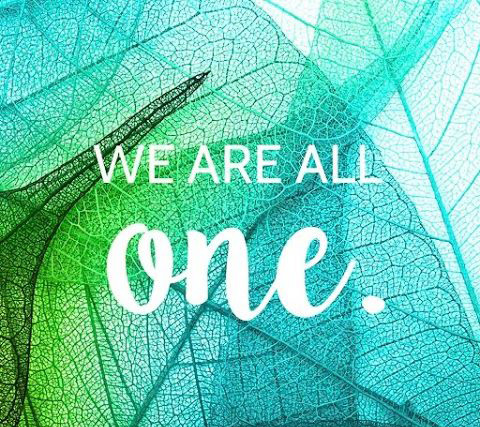
One.jpg

Have you ever learned a new word or phrase, and then come across that word of phrase frequently afterward? Is this a coincidence or did your mind simply filter out what it didn’t recognize or understand before?

I remember with unusual clarity the first time I heard the words, “That All May Be One.” It was back in 2003 and I had just started a brand new job working as the Communications Director for the Sisters of St. Joseph. Although I grew up Catholic, I had never worked for a religious organization before. My initial reaction upon hearing that this phrase was the essence of the Sisters’ mission of unity, which I would be responsible for sharing with the world, was: “huh?”

Coming from the corporate world where the only mission anyone cared about was how to make money, I wasn’t sure what this phrase meant or what I was supposed to do with it. But like a guitar string being plucked, something about these words resonated in me. I needed to know more. Not only to do my job well, but because I felt a deep connection to this bold and new (to me) idea.

guitar.jpg

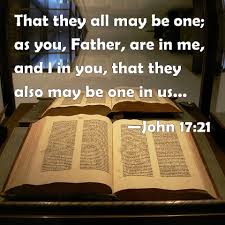
So I studied the Scripture from where these simple words come (John 17:21). I considered the enormity of them. Are all living things really connected? Does everything we do and say and think affect everyone and everything else? And God? And all creation? I knew that I had found something that would change me, and that I would never look at the world in quite the same way again.

John17.21.jpg

Fast forward 15 years. Today, I believe in these words that form the basis of the mission of the Sisters of St. Joseph more than ever. But the idea that all living things are connected to one another and to God no longer feels revolutionary to me. It now feels more like, “Of course we are! How could we not be?” And this idea exists not only in a religious or spiritual context, but seemingly everywhere I look. Even in popular culture. In places you might least expect.

For example, the House of Blues has this sign above the stage in Las Vegas, and variations of it in many of their different locations. If you look closely, you can see representations of all the world’s major religions on either side, and in the middle the words, “All Are One” are written in the space above the words “Unity In Diversity”.

HOBPhoto.jpg

Many of my favorite songs include the concept, which I had not paid much attention to before. In “One Love” by reggae artist Bob Marley, he sings, “One love, one heart, let’s get together and feel alright.”

In “Imagine” John Lennon sings,
Lennon.jpgIrish rock band U2, who’s lead singer Bono has championed many human rights issues, crystallizes human connectedness in their song, “One”:
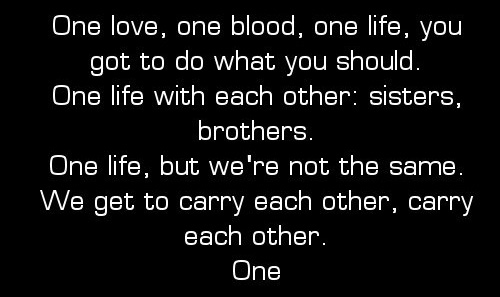


U2.jpg
Many movies have this theme running through them as well. In the latest adaptation of “The Three Musketeers” released in 2011, the famous “All For One and One For All” cry carries more meaning than for just their small group. In the Lion King franchise, we see wise King Simba echo this throughout as he rules his kingdom.

giphy (45)

Even Starbucks got into it last year with their highly anticipated Christmas cup design. Here is their Facebook explanation of the design:

Starbucks
Now that I am aware of it, I see the mission of the Sisters of St. Joseph – that all life is connected with each other, and with God – in so many different places. Perhaps you’ll see it now too.

About the Author

NewProfilePic.WEB
Gina Sullivan is the Director of Communications for the Congregation of St. Joseph, and is also a Congregation of St. Joseph Associate. She is the mother of two daughters ages 19 and 16. In her free time, she enjoys cooking, walking, reading and experiencing new places and people.

Image

Do You Know a Muslim?

By Sister Mary Jo Curtsinger

Do you know a Muslim personally? That happens to be the first question on Georgetown University’s 2016 Bridge Initiative survey of American Catholic public opinion and portrayals of Islam. Get this: Catholics are less likely than the average Mary Jo on the U.S. streets to know a Muslim personally. Only 3 in 10 Catholics say “Yes.”

So do you? Know a Muslim? Personally, that is? If you say “Yes,” survey says you are much more likely to have a favorable impression overall of Muslims.

This finding said to me: In these days of a rising discriminatory practice and Islamophobic rhetoric, spikes in hate crimes, governmental actions curbing the influx of refugees and immigrants from Muslim-majority countries…can we just do something to respond to our church’s call to solidarity with our Muslim sisters and brothers?

That’s the plain-talk version of my doctoral thesis-project proposal, and here’s what I’ve been up to:

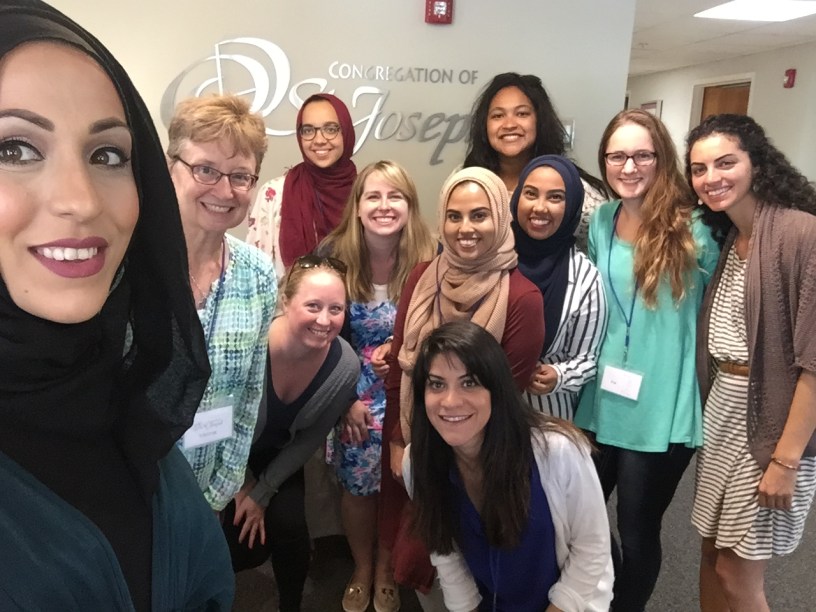
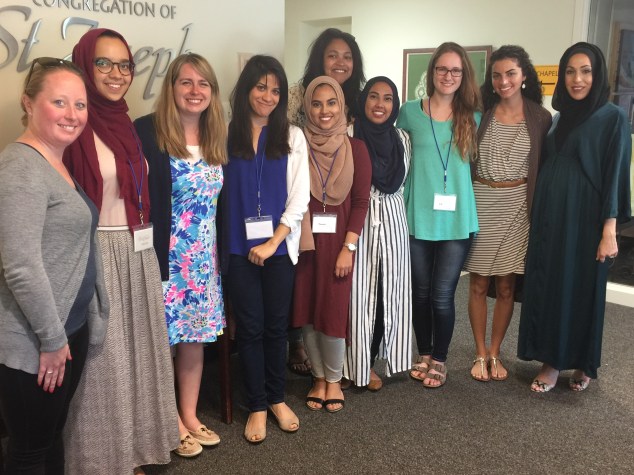
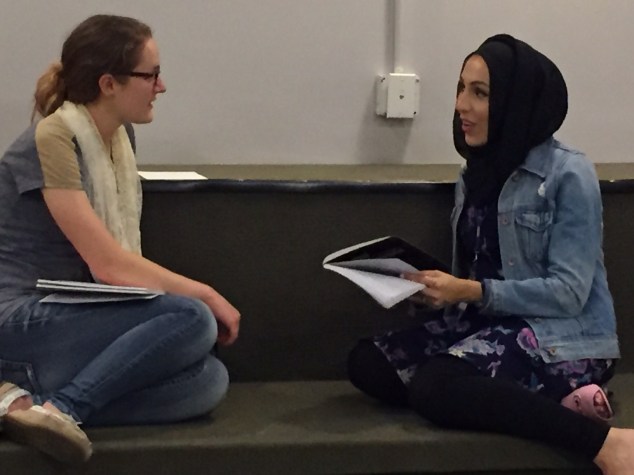
This summer I searched and found five Catholics and five Muslims (aged 22-28) who were committed to their own religious tradition, but were newcomers to interfaith circles, and who were willing to gather for four Sunday afternoons in August to get to know one another.

Four weeks later, this is how it looked:

MJ 1.JPG
This picture is surely worth at least a thousand words. But here are some of these ten women’s words.

I asked them at the end of our time together to complete these sentences:

My overall feeling about having participated in these sessions is_____________.

Their answers were:

Grateful.
Inspired.
Empowered.
Enriching.
Fortunate.
Unified.
Fulfilled.

One key outcome of these gatherings for me is an increase in ________.

Their answers?

Hope.
Understanding.
Awareness.
Conviction.
Love.
Exposure.
Sisterhood.

“Sisterhood” indeed evolved among us. Around the middle of our time together I realized that the women had started referring to each other as “our Muslim sisters” and “our Catholic sisters.” Amazing.

Yet there was not a magic formula for getting there. Change happened because these faithful and smart young women asserted that our shared humanity would be the common ground for opening themselves to appreciative learning from one another, in a spirit of respect, humility, and courage.

Once we framed our time together this way, it becomes easy to relax and just have fun.

MJ 2.jpg

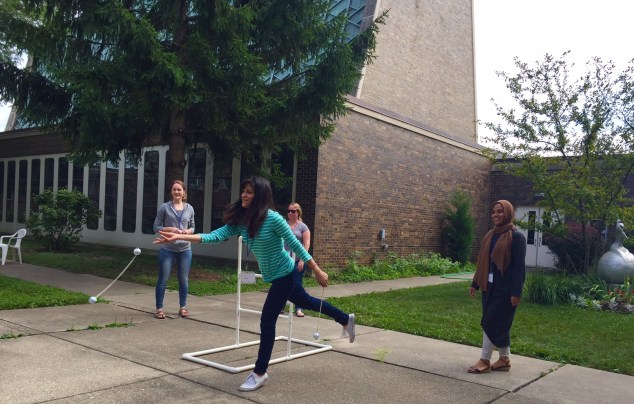
One-on-one walks together were part of every gathering. Taking walks together is something friends do. Enjoying the beauty of creation together was clearly part of the appeal.

MJ 3.JPG

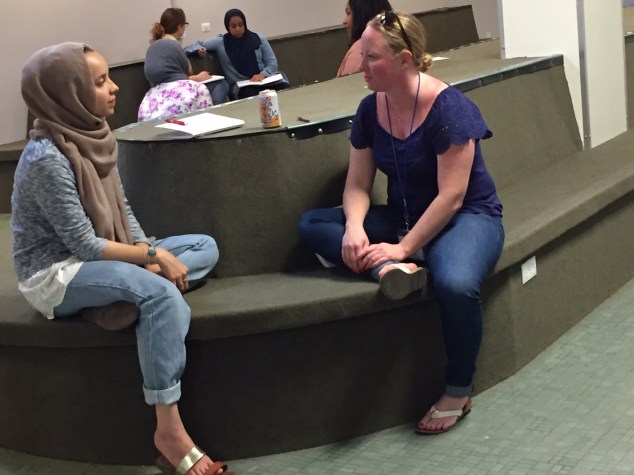
Our first and fourth meetings were at the CSJ Center in LaGrange Park, the middle two at the American Islamic College in Chicago. Day Two featured “speed faithing,” (a variation on “speed dating.”) Every Catholic paired with every Muslim for about 8 minutes, rotating around when I signaled time-to-move-to-the-dear-neighbor. Here they got to satisfy their curiosities about the what, why and how of spiritual practices, beliefs, family and community life, whatever they wanted to ask!

MJ 4.JPG

In the third meeting we expressly set out to learn the “joys and griefs” of being faithful in our society today. Listening and sharing shifted down into a palpably deeper gear.

MJ 5.JPG

At our last gathering, I introduced the prayer practice of sharing the state of the heart. This is the simple, profound way that Sisters of St. Joseph have prayed together since our 17th Century founding. I would say that many moments of such sharing had transpired even before these women knew what it was called.

MJ 6.JPG

When I gaze upon these photos again, I am awestruck and humbled to realize that God worked out some unity and reconciliation through my efforts. I say it’s no small thing to help God engender hope, gratitude, and love in people’s hearts.

Yes, I know some Muslims personally. They’re my sisters, actually.

MJ 7.JPG

If you’d like to do more reading about Muslims and Islam, here are some trustworthy and eye-opening sources:

Duffner, Jordan Denari. Dialogue and Danger: Report on American Catholic Public Opinion and Portrayals of Islam. Survey findings, Prince Alwaleed Bin Talal Center for Muslim-Christian Understanding, Georgetown: Georgetown University, 2016. http://bridge.georgetown.edu/danger-dialogue-american-catholic-public- opinion-and-portrayals-of-islam/
Esposito, John L., and Dalia Mogahed. Who Speaks for Islam? What a Billion Muslims Really Think. New York: Gallup Press, 2007.
Lean, Nathan. The Islamophobia Industry: How the Right Manufactures Fear of Muslims. London: Pluto Press, 2012.
Mattson, Ingrid. The Story of the Qur’an: Its History and Place in Muslim Life. Oxford: Blackwell, 2008.

About the Author

Mary Jo cropped for bio
Sister Mary Jo Curtsinger is a former school psychologist and high school teacher of theology. She is now working on a doctoral degree at Catholic Theological Union. She loves movies, dancing, and little kids.