
Image

Sisters Wear An Invisibility Cloak Every Day!

Confession: I am a Harry Potter fanatic. I have read the books and seen the movies more times than I can count, and could recite most of the lines for you if asked (no one does :-). So, it should be no surprise that in a recent meeting when a sister said, “I’m just going to put on my invisibility cloak,” my mind immediately went to young Harry, opening his first ever Christmas present, and finding an invisibility cloak inside. If you’re unfamiliar with the movies or this particular scene, you can watch it here.

giphy (27)The cloak ends up playing amajor role inHarry Potter lore. Harry, along with fellow wizards-in-training Ron and Hermione, use the cloak to get into all manner of mischief, from sneaking around the castle to playing pranks on friends, but then ultimately using it in their quest to defeat the villain of the series, Lord Voldemort. But the sisters’ comment that day got me thinking. The invisibility cloak from the Harry Potter series is very much like the “invisibility cloaks” often worn by women religious as they move about and minister in our communities.

Here are 5 things Harry Potter’s invisibility cloak and sisters have in common:

giphy (28)

  1. They move around the world unseen.
    While they are not using their invisibility to sneak past teachers in the hall, the invisibility cloaks of sisters do allow them to move through the world without being noticed. Since Sisters of St. Joseph no longer wear the habit that many people still associate with women religious, they are once again able to move through our communities without calling attention to themselves, as they did way back in 1650 France when they first formed. Wearing plain clothes means sisters are no longer seen as “separate” or on a “spiritual pedestal,” but it also means you may not know when you are seeing a sister.

    giphy (29)
  2. They work for the good of others.
    More often than not when employing the invisibility cloak, the characters in Harry Potter have altruistic goals. They are trying to uncover the keys to a perceived danger or help a friend escape trouble. In this same way, the invisibility of sisters is used for good. The Sisters of St. Joseph’ mission is to bring all into unity with God, with one another, and with all creation. They, along with their partners in mission, do this through prayer, direct service and ministry, standing with and for the poor and vulnerable, and advocating for systemic change. By putting themselves in the background, they are able to focus on the needs of others and our world.giphy (24).gif

  3.  Many people don’t know about them.
    “There are still nuns?” “How would I have known you’re a sister?” “Why don’t you wear a habit?” You’d be surprised how often we hear these questions. We know that there are many sisters living and working in communities all over the country and the world. But many people’s idea of what a sister is, or should be, means that they don’t see sisters in their lives. Just as many of the adults in Harry Potter don’t suspect that the students are using an invisibility cloak to get around undetected, many people don’t realize that sisters are around either! In fact, you’ve probably talked to or seen a sister out in the community and not even realized it.

    giphy (25).gif
  4. They helps us in our most human moments.
    Ok, so I know that humans are not actually invisible. But in a poignant scene, Harry has just learned that his parents were betrayed by one of their best friends. Upset, he uses the invisibility cloak to seek solitude in his pain. Who hasn’t wished for the ability to disappear from the world in times of trouble? But what is even more important about this scene is that Harry’s friends don’t just let him go off on his own. They follow him, letting him lean on them for support. While sisters may seem to wear an invisibility cloak to much of the world, they are also always surrounded by a community of other sisters who understand their struggles and support them in their most human moments.giphy (34).gif

  5. They are an unexpected gift.
    When Harry comes downstairs on that first Christmas morning at the castle, he does not expect to receive any presents. He has never received Christmas gifts at all, let alone a gift that is such a magical, and ultimately important, one. When one becomes a sister, the gift of invisibility is not one that is expected. But their ability to do good in the world, to move through our communities and help others sight unseen, is a true gift.giphy (35).gif

So the next time you watch Harry Potter, remember the Sisters of St. Joseph and how, like Harry, they sometimes wear invisibility cloaks. While you may not always be able to see them, they are still here, working in the world and praying Jesus prayer, “that all may be one.”

About the Author

Elizabeth-Powers,-WebElizabeth Powers is the Electronic Communications Coordinator for the Congregation of St. Joseph and manages the blog, Beyond the Habit. She sometimes acts as a contributing writer when faced with a particularly poignant, sister-inspired moment. She loves reading, writing, and Harry Potter.

Welcome to My House: An Anthropological Study

By Sister Carol Crepeau

source (2).gif

Welcome! I want to invite you into my house, my home. It’s actually an almost-100-year-old-farm-house-turned-rectory that the Sisters of St. Joseph rent from an Episcopal parish. Two of us live here in Helena House, Sister Jackie and I, but in reality many in our Congregation and neighborhood have experienced this homes warmth.

Thinking about our house I started wondering, what would an anthropologist, that is, one who tries to figure out what makes humans human, who studies the origins, the behaviors, the physical, social, cultural reality and the developments of humans, say about Sister Jackie, me, and our house?

I’ll bet that an anthropologist (let’s name her “Ms. Anthropologist”) would concentrate on three aspects of Helena House:

  • The Dining Room
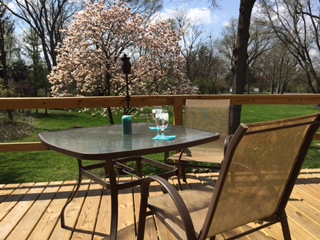
  • The Deck
  • The Refrigerator Door

These three areas could serve as symbols, or even better, examples, of what make my housemate and I most human, most whole, and, hopefully, most holy.

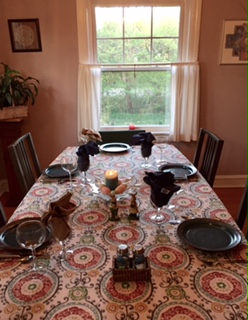
I would imagine that, upon visiting our home, Ms. Anthropologist would have questions for us about these three areas. For example, why, since there are two sisters living in the house, do you have a dining room table that seats ten?

FullSizeRender

In a very real way, our dining room table is as sacred as an altar in a church. The Sisters of St Joseph was first founded in 1650 in Le Puy, France by a Jesuit priest and six women in a kitchen that contained a large table. For Sisters of St Joseph, gathering for a meal is an extension of Jesus dining with friends. If we squeeze together at our table, we can even seat 12!

Ms. Anthropologist might then ask, why the deck? The deck is our outside gathering place for experiencing life in Spring, Summer and Fall. Often times we are visited by seven deer, including a buck, two pairs of mourning doves, countless warblers, one yellow tail hawk and of course robins, cardinals and blue jays, chipmunks and squirrels. There is something wholly perfect about wine, cheese, close friends, neighbors and nature.

IMG_1582

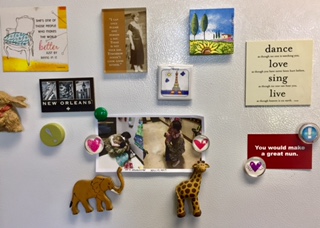
Finally, Ms. Anthropologist might ask about the refrigerator door. After all, aren’t most people interested in the contents of the refrigerator?

But for us, our refrigerator door is really an illustration of our lives. It is our bulletin board, art gallery, and where we post artifacts of significant people, places and things in our lives. When Ms. Anthropologist studies the refrigerator, she will see a number of magnets, each symbolizing some significant realities in the lives of myself and Jackie. Magnets from places we’ve been: New Orleans, Le Puy, Seal Beach, Tanzania. In the center of the door, right now, is a photo of an Air Force Doctor hugging his daughters’ good-bye as he leaves for deployment in Afghanistan – he is Jackie’s nephew, Matt.

FullSizeRender2.jpg

Ms. Anthropologist might notice a couple of magnets with quotes on them:

“You would make a great nun.”

And my favorite

“DANCE as though no one is watching you, LOVE as though you have never been hurt before, SING as though no one can hear you, LIVE as though heaven is on earth – Souza”

FullSizeRender4.jpg

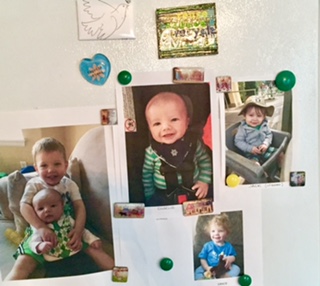
On one side of our refrigerator lives our list for the store. On the other? The refrigerator bulletins the photos of the next generation of children in our families – Ms. Anthropologist might see Mason, Charlie, Gracie, Jack, Lila…the most recent photos, all depending on our families’ current Facebook activity.

FullSizeRender3

Finally, Ms. Anthropologist should know that there are two principles of spirituality that underpin life at Helena House:

St Irenaeus in the third century proclaimed, “The glory of God is a human being fully alive.”

Jean Pierre Medaille SJ, our Congregation’s primary founder, wrote: “Let the Sisters live that they will become fully human, in glory and grace, with God and the dear neighbor.”

Hopefully, Ms. Anthropologist’s study, and our own, concludes that Helena House is truly a warm, welcoming, unpretentious, real home, and that hospitality, a core value of the Sisters of St Joseph, is an important reality for the two humans who live in this home.

About the Author

Sr. Carol photo editedSister Carol Crepeau, CSJ ministers as a facilitator and leader of group dynamics for non-profits. Guiding the annual Congregation of St Joseph Pilgrimage to LePuy and Lyon, France is one of the most wonderful activities of her life. She also enjoys a good book and gathering with friends for prayer and conversation.


Image

Keeping Focus During First Communion

By Sister Jean McGrath

After many years as principal in a large parish school, spring time has become synonymous with First Communion. For weeks preceding the celebration, the anticipation increases exponentially for our second graders. Because I began my career in education as a second grade teacher, the event always holds special significance and an awareness that although times have changed, the day is always a memory maker.

Despite my best attempts to provide age appropriate theological reflection on the significance of the sacrament, attention to other details often took precedence over my desire to plan grace-filled days of preparation.

giphy (23)

First, there was the dress.  Would the church be filled with mini brides and prom queen wannabes? Move over Louis Viutton, our communicants had beautiful white plastic purses with mini missalettes and tiny white gloves inside.

boys-1732884_1920

The boys were at their sartorial best, often in bow ties and suits that suggested a board room position at the local law firm.

communion-cake-edits 2

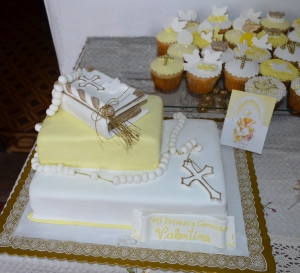
First Communion cakes were adorned with lilies, crosses, and gold cups the size of small kettles.

My how things have changed!

Today, First Communion gifts like silver miraculous medals have been replaced with iPhone 6s.

Perhaps the greatest evolution has been in the way we encourage the communicants to be on their best behavior. “Be good because your guardian angel is on your shoulder” is now, “Be good, the videos are capturing every moment.”

guardian angel cropped

One could easily be discouraged. Did we lose the beautiful meaning of this precious sacrament to the commercialism of pretty dresses and after mass parties?

Absolutely not!

On the Monday after First Communion I ask the second graders to tell me about the most special part of the day. “When I went to Mass yesterday, I had my second Holy Communion with my mom and dad.” “My Nana gave me her rosary.” My personal favorite from last year: “When I was in Church, I felt like Jesus really loves me even more.”

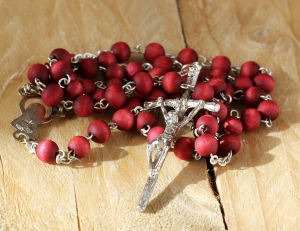
rosary cropped

Each year at the beginning of the First Communion Liturgy, our Director of Religious Education invites all present to close their eyes and think about their own First Communion and about the child who invited them to this very special Mass. Each year it is a moment of grace for me as I think about the thousands of Communions I have had since my first. I invite you to do the same. You may be amazed at the graces and blessings you will remember.

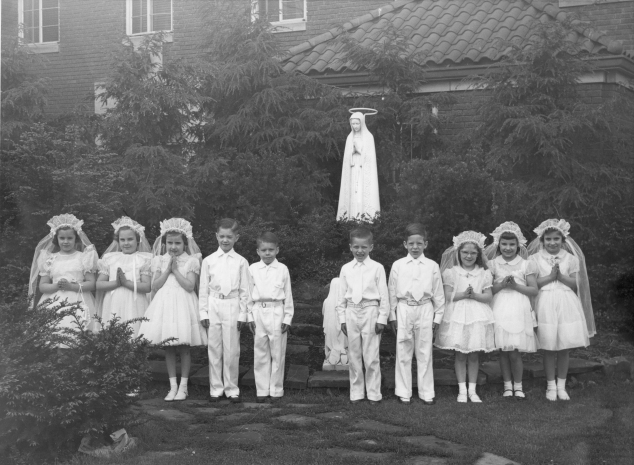
First communion historical photo, cropped

But be careful, the videos will be rolling.

About the Author

JeanMcGrath


Sister Jean McGrath is principal at St. John Fisher School in Chicago and enjoys a good book, a good conversation, and a great bargain.

Image

Can We Talk? Speaking the Language Known ‘Round the World

By Sister Mary Jo Curtsinger

Oi! That’s Portuguese for “Hi!” I’m writing today from Itu, Sao Paulo, Brazil, where Sisters of St. Joseph have just finished hosting an encontro, or gathering, of younger sisters and mentors in Latin America.

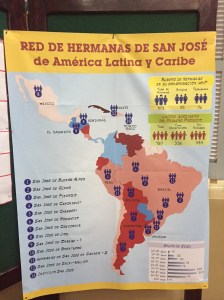
map
You can find Sisters of St. Joseph
all over Latin America, and the world!

What’s a sister from Chicago doing at a meeting for Latinas in Brazil? Happily, I was invited (I didn’t just crash the party!) and I jumped at the chance.

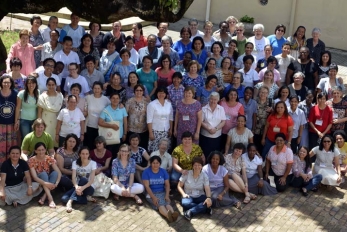
It turned out there were almost a hundred of us—many from Brazil, as well as some from Peru, Argentina, Bolivia, and Haiti. There was also a sister from Mozambique, one from India, myself from Illinois as well as a sister from West Virgina. Yes, Sister Barb McCartney and I were the only two from the Global North. We were welcomed with love beyond imagination, yet it was an enlightening experience to be the relative “outsiders” as English speakers.

All sisters
We all came together,
and learned to work through the language barrier!

So, okay, let’s talk “language.”

Our presenters spoke Spanish, which was mostly understood by the Portuguese-speaking Brazilians. Every once in a while, the women listening to Spanish with Portuguese “ears” would raise their hands and say the Portuguese equivalent of “wait, wait, I don’t know what the heck you just said!” The Haitian sisters spoke French and Creole, but their mentor understood Spanish, and so translated for them.

Sister Barb and I knew enough Spanish between us to get us into conversation with other sisters, but nowhere close to enough to get us all the way through. So luckily, we were provided with the translation services of Brazilian Sister Bette. Other sisters sometimes pitched in to help Sister Bette get ideas across to Sister Barb and me (It took a village!)


Mary Jo and other sisters

That’s me, on the left, with Sister Barb (right),
smiling because Sister Bette (middle) had our back!

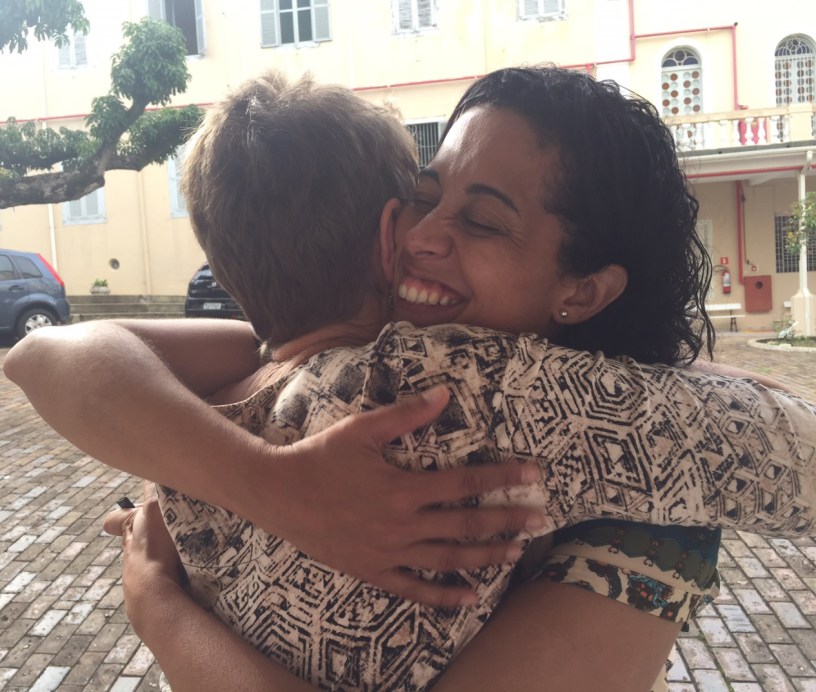
Sometimes we could feel the discombobulation of it all. But, for the most part…it worked! It’s amazing how quickly sunny smiles and warm hugs break the ice! And the Latina sisters communicated unsparingly with these affectionate media. Song and dance-y movement introduced every session.

The purpose of coming together, after all, was to open ourselves more deeply to our common spirituality and life: echoing together the prayer of Jesus that all might be one, ourselves with the dear neighbor “without distinction,” even as we are one in God (John 17:21). One could expect a good bit of relating in such a group, right?

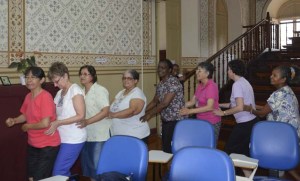
sisters dancing conga line, cropped

Communication can come
in many forms, even a conga line!

The ingenuity of the organizers was in fashioning many of the prayer times such that they were less dependent on words. Prayer was often centered on gesture and music, images and imagination, symbol and gazing. In so doing, we were able to share our hearts without the frustration of the language barrier. Upon reflection, I realized that this freed up some of my energy while staying totally engaged. It was quite moving, really.

And heavens to Betsy! These Brazilian sisters knew a LOT of songs in common! It felt like we were hanging out with Maria and the von Trapp family singers. There were also evening dances that were crazy fun. For one, sisters wore traditional ethnic dress; for the other, the Brazilian sisters kept the contemporary tunes flowing. We didn’t need to speak the same language to understand the joy in song and dance!

sisters dancing in garb, 2

Song and dance is joyful,
no matter your language!

So, what I observed is that my Latina sisters’ spirituality is very much embodied. They are very comfortable in their own skin, and relate to one another with touch, embrasos y besos (hugs & kisses) as well as pats on the shoulder and hand-holding. And there are always vibrant smiling eyes to meet one another.

What an amazing trip! What a wonderful way to remember and deepen our understanding that we are “bearers of the tradition,” carriers of the charism of unity and reconciliation, at the same time as our Sisters and Associates of St. Joseph all around the world. We are all more the same than we are different, all speaking in the language of unity and love. I’m leaving Brazil with a deeper sense of gratitude for the gift of belonging to the “Congregation of the Great Love of God.”

Obrigada! That’s Portuguese for “thank you!”

About the Author
CurtsingerMaryJo.jpg

Sister Mary Jo Curtsinger is a former school psychologist and high school teacher of theology. She is now working on a doctoral degree at Catholic Theological Union. She loves movies, dancing, and little kids.

Flying, Time Travel, and a World Without Borders

Timezone
By Sister Christine Parks

As I begin to write this blog, I am sitting at 35,000 feet, headed back east toward Chicago at 600 mph. Amazingly I will arrive home the same day, several hours before I left Tokyo—and so I wonder: will I be younger when I arrive than when I left? If I kept traveling east would I keep getting younger—would I be able to see the most immediate past a bit more clearly? I suspect not, but that’s just one of the mind-twisting mysteries of time-traveling the globe by jet.

pexels-photo-195477

Many of us have been here,
35,000 feet up with only our thoughts!

Another “mystery” is that if I were able to see the ground below this plane there would be no lines (neither latitude nor longitude.) There would be none of the artificial boundaries we have erected to separate ourselves from others—those we determine to be “not us”; those whose differences we build into impenetrable walls rather than invitations.

travel-1767532_1920

What other “mystery” lies beneath the clouds?

Looking down through the periodic breaks in the clouds I can see all the structures of the amazing geography of this globe that is our home. The landscape unfolds in rivers, mountains, prairie, forests—large and small, and the inevitable signs of human habitation.

The one thing I can’t see are the borders, the thin blue lines that cover every map. Lines that divide us from each other. Boundaries that we try to mark out with checkpoints, fences and walls. Lines that we sometimes seem all too willing to kill and die for.

pexels-photo-46058

Looking down from above, the landscape is beautiful.
And borderless.

These past couple of months I have been trying to figure out what it is that is happening in our nation and world. Trying to puzzle out the swirling chaos. Trying to frame this in my sense of the difference between our Congregation of St. Joseph charism of unity, with its appreciation of diversity, and our all too human temptation to seek uniformity in thought, religion, relationships, and so many other aspects of life that creates division.

pexels-photo-346885

You can’t hold the whole world in your hand,
but you can try to hold it in your heart.

And yet some of us yearn for the unity promised by our experience of the Holy. We yearn, seek and pray for the union that respects and reverences the incredible diversity we see all around us. The diversity that gives the rich texture of wonder and beauty to this world that is our home. That is what I see outside this window; what I hope for in the world around me; what I seek inside myself.

About the Author

Christine Parks

Sister Christine Parks currently serves as a member of the Congregation of St. Joseph Leadership Team. Her leisure activities include gardening, long walks in nature, reading, writing, attending plays and concerts, as well as museums.

Image

Konnichiwa! Reflecting from Japan

 By Sister Jeannie Masterson

When I entered the convent 55 years ago at the age of 18, I assumed that I would teach elementary school in Cincinnati all my life. The furthest thing from my mind was that I would travel to Japan! Yet, in the past 9 years as a part of the Congregation Leadership Team (CLT), I have been to Japan 17 times – in fact, I’m in Japan as you read this! The delights are many, from coming to know our Japanese sisters to being introduced to an entirely different culture.

japanese-departure

Our sisters have always gone where they are needed,
and in 1950, they went to Kyoto!

When in Japan, I am constantly challenged to open my mind and my heart to another way of thinking, speaking, living. I’ve learned how instinctively I assume that “my way” is the ONLY way, and how often I am dead wrong about that. I am by nature direct in my communication; Japanese are circular. I expect immediate decisions; Japanese need to mull thoughts over time. I think in terms of what I want; Japanese hardly have vocabulary for “I” as they focus on “we”. I have food preferences because of familiarity, for which there are no comparable options in the Japanese cuisine. I expect traffic delays, whether on the highway or at the airport; Japanese are extremely punctual and reliable – as a matter of fact, should a taxi not be at least 5 minutes early, the passenger will receive a phoned apology and a new arrival time!

img_0086-cropped-two

I’m not sure where I was heading in this picture,
but I know I got there on time!

While in Japan, I find myself listening differently now than I did on my first visit: what’s beneath the words? What are the words for which our meanings are totally different without our realizing it? Where are the hidden assumptions, on both sides – those beliefs that are so ingrained that neither of us ever thinks to say out loud? How do I comprehend and appreciate those assumptions that refuse clear translation, when I’m never there for more than ten days?

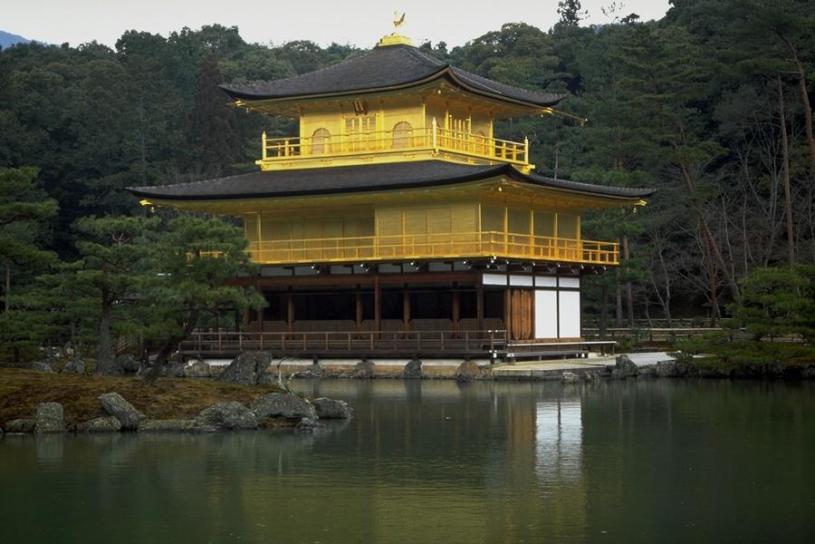
japan005

We may have words with different meanings,
but we all agree that this building is beautiful!

The central value of the Congregation of St. Joseph is unity – Jesus prayed “that all may be one”. These exposures to Japanese culture invite me to pray more deeply to understand what “unity” means: surely it doesn’t mean blending so that neither culture is maintained. It brings me to the realization that our world contains hundreds of cultures, each unique and developed and cherished. How do I cultivate true respect for each, neither imposing my ways on them, nor fearing their influence on me? How can I continually be conscious of, and appreciate, their multiple gifts to the totality of the world?

japangroup2-10-16

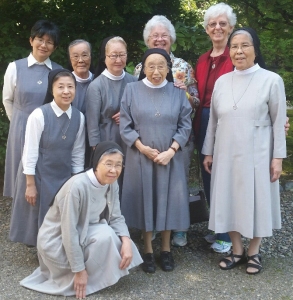
We are all one! Whether from Japan,
the United States, or anywhere else in the world!

Going to Japan calls me to think global, to open myself to new understandings, to acknowledge that we Americans are not the center of the universe. We are part of a whole, and the more we work to bring the whole together – rather than divide it – the more amazing that whole will be.

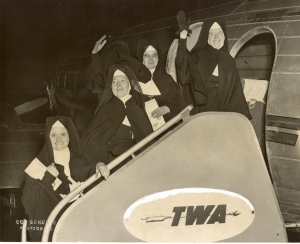
In 1950, the Bishop of the Diocese of Wichita asked Sisters from our founding community of Wichita to establish a clinic for the poor in the Diocese of Kyoto, Japan. Since our first sisters arrived, our congregation has ministered to those in need through engaging in  healthcare, senior care, education, and retreat ministries in Japan. Sisters from our Congregational Leadership Team visit our sisters in Kyoto and Matsusaka twice a year.

About the Author

jeannies-picture-2015Sister Jeannie Masterson is currently serving her second term on the Congregation Leadership Team. Earlier she served in provincial leadership, teaching, high school administration, and as a pastoral associate for adult formation. Sister Jeannie was the founding and active director for eight years of Cincinnati’s Jordan Center, which brought health attention to uninsured working people and their families.

“Can I Have This Dance for the Rest of Your Life?”

By Sister Marcella Clancy

I don’t know when I realized how much I love, no, need to dance. I am amazed others are able to stay stock still when a “lively” tune begins. The music strums the very fibers of my being and I must move, sway, or at least tap my foot. I never took dancing lessons yet there is something about dance that lifts my heart, improves my mood, and makes my spirit joyful.

giphy-14
Dancing Makes Us Joyful!

How delighted I was to learn that in Eastern theology a Greek term, “perichoresis” (pronounced per-ee-kor-ee’-sis) is used to describe the inner relationship of God. Our English word choreography is derived from it. Perichoresis suggests a dynamic interaction, a movement of intimacy and receptivity within God and between God and all creation. God is a Divine Dance!

As Sisters of St. Joseph, we promise to “move always toward profound love of God and of our ‘dear neighbor’”. This could evoke an image of climbing a long, arduous ladder of love. The image of God as a Divine Dance suggests an alternative concept that for me more accurately describes my relationship with God.

giphy-15

Who doesn’t love to twirl?

A round dance of individuals weaving in and out, whirling, twirling, spiraling around and about each other to a contagious beat, responding to each other’s movements, moving separately yet not independently requires:

  • A willingness to let go, to focuses less on personal control and self-consciousness and more on yielding to the  vitality of the dancing itself.
  • A creativity that flows unimpeded. There is a free expression of self that is so much more than the repetition of memorized steps. One is attune to an inner movement that itches to express itself in the outer movement of the body.
  • A receptivity that is open and responsive to the rhythm of the music and to the living energy and charisma expressed in the other dancers. When receptivity is at its peak, the dancers dance as one.
  • A surrender to joy, to laugh at one’s missteps and accept the missteps of others, allowing the delight of dancing itself, not its perfection, to be both one’s motivation and one’s goal.
giphy-16
We all hear the music

These four qualities guide me in my relationship with God.

  • The Image of God as a dynamic Divine Dance beckons me to listen attentively to my own heart. What God wants is inscribed in my own heart. “I will put My law within them and write it on their heart.” (Jer. 3:33) What inspires me, touches me, draws me? What is life-giving for me? There. There is found the Divine music to which God invites me to dance.
  • Yet I am not the only dancer. All around me are others who moving to their own inner music. Their steps may be different than mine yet to be fully faithful to the dance I must be open and receptive to the unique energy and charisma each dancer expresses. They teach me new steps. I absorb their energy. I am not the choreographer of the dance. God is. “May they all be one.” (Jn. 17:21)

giphy-18

Don’t worry about the right steps,
just dance!
  • Often my greatest concern is the “right steps”. When that is my focus I become rigid, stiff, exacting. My focus is myself rather than the rhythm and beat of God’s living music and movement. The more I am able to surrender myself to the Divine music and movement flowing in and around me and in and around all creation the better dancer I become.
  • God does not play dirges. “I came that they may have life and have it more abundantly.” (Jn. 10:10) In times of sorrow and pain God draws close with a Divine melody that is comforting, caring and attentive. When my own missteps are the source of shame and suffering, God switches to a tune that both forgiving and healing. Always God finds me where I am and plays a Divine tune that slowly beckons me back to joy. “I want My joy to be in you and in you to reach its fullness.” (Jn. 15:11).

woman-happiness-sunrise-silhouette-40192

You can always find joy
in the dance with God

God longingly invites:

“Could I have this dance for the rest of your life?

Would you be my partner every day and night?

When we’re together it feels so right.

Could I have this dance for the rest of your life?”

About the Author
marcella

Sister Marcella Clancy currently lives in the Detroit area. She offers spiritual direction, serves on Congregational committees, and companions one of our newer members. She loves long walks, good movies, and leisurely lunches with friends.


Image

Journey to Social Justice

By Sister Sallie Latkovich

As a young child, I loved to visit my Grandmother, whom we called Nanna. The poor and the homeless of the time knew that they could come to her back door to receive something to eat. She often invited them in, to eat at her table and to share some conversation. I loved meeting these people, and I loved Nanna’s kindness to them. This was how my heart for justice came to be. I define justice as “being in right relationship” with all people.
chairs-black-and-white

As a high school student, I would board the bus at my high school every other Saturday to go to the Hough area of Cleveland (where race riots erupted in the early 60’s) to tutor young students in reading and in math. Over the course of a year, relationships grew; and I became incredibly aware of the injustices faced by the people who lived in Hough.

bus

As Director of the Biblical Study and Travel Program at Catholic Theological Union, I have accompanied our students over the last eight years for an extended time of study in Israel. Our “home” for eight weeks has been with the Comboni Sisters in Bethany, which is in East Jerusalem. The security wall actually borders the sisters property.

On a global scale, my consciousness was raised about the subtle and not-so-subtle oppression of the Palestinians. Friends I have come to know in Bethlehem have had large parcels of vineyard property, which had been in their family for several generations, taken from them and they have no recourse. Students at Bethlehem University, both Christians and Muslims, who live outside of the West Bank have great difficulty passing through check points to get to classes. Taxes on the Palestinian population are very high, with very poor services provided in return.

fecnes

These experiences among so many others have formed my heart for justice. The Prophets of the Old Testament, which was my main area of graduate study, always called for justice within the monarchy of Ancient Israel. Because of this, it was natural for me to both study and to embrace the Best Kept Secret in the Church: Catholic Social Teaching. It also led me to choose religious life with the Congregation of St. Joseph, where our core value is unifying love.

sister-corita-thanksgiving-1

Catholic Social Teaching is a collection of documents written by Popes, Bishops’ Conferences, and Individual Bishops in response to issues of justice. From 1891 to the present, the hierarchy of the Church have called for justice as they have written documents on behalf of peace in the world, against the death penalty, welcome and care for immigrants, and others.  All of these issues of Catholic Social Teaching are rooted in the Gospel of Jesus.

peace-marilynnichol

These documents are little known; indeed, “The Best Kept Secret” in our Church. Why is this so?

–they are often written in “church-speak” and are lengthy; because of this, they are not user-friendly to the general population.

–they are prophetic in that they speak truth to power; truths that “power people” are often unwelcome to and even resisted.

–they are often unfamiliar to many clergy who then are unable to incorporate Catholic Social Teaching into their weekly homilies.

img_8757

For the Congregation of St. Joseph, our own documents call us to be “the community of the great love of God!” always in service to “the dear neighbor,” without distinction. These phrases speak of justice: being in right relationship with God and with others in our world, both near and far. I find my own heart for justice has a home in the Congregation of St. Joseph, for we embrace Catholic Social Teaching and make every effort to act on its directives. May we all speak for justice in our world, as Catholic Social Teaching calls of us.

About the Author

sallie-sized-for-useSister Sallie Latkovich directs the Bible Study and Travel Program as well as the  Summer Institute at Catholic Theological Union in Chicago. As a member of the Bible Deptartment, she teaches Biblical Foundations of Spirituality and The Bible For Ministry. She enjoys music, plays, and movies; and loves visiting family and friends.



Birds of a Feather Flock Together! Five Ways Living as a Sister of St. Joseph Put Me in Touch with my Inner Goose

By Sister Judith Minear

As a little girl, I didn’t think much of geese. Their reputation suffered in expressions I heard, like “you silly goose” and “well, that was a wild-goose chase!”  People around me had a million of those phrases, and I was the recipient of them a little too often.

giphy-11

Now I know what a wild-goose chase is!

Fast forward several years into my vowed life as a Sister of St. Joseph. People often asked me (and still do!) what it’s like to live in religious community as a sister. While I had a deep sense of what this community meant to me, I wasn’t always able to communicate it well. Then one day, at a Congregation of St. Joseph gathering, the sister giving the keynote address said she was going to speak about how much Sisters of St. Joseph are like geese. “Great,” I thought. “My goose is cooked!” But then, what she said hooked me. It gave me goosebumps. So let me share her wisdom, as well as my own thoughts on why it’s great to be a goose!

  1. Geese are not afraid to stick their necks out. When something or someone we love is in danger (and sisters and associates of St. Joseph love every kind of neighbor. No holds barred), we aren’t afraid to stick our necks out and engage in change. To honk loudly (and respectfully, out of Great Love) when necessary. We do not run away from difficult situations. Instead, we seek to be a loving presence and an agent for change, standing shoulder to shoulder in the midst of others.
giphy-12
We don’t hide from the tough stuff!
  1. A goose falling out of formation feels the resistance of the drag and falls back into formation to feel the lifting power of the birds around it. This is one of the best expressions of the gift of community life I have ever heard! From my earliest days in the community, I have watched sisters and associates reach out to one another to lend a helping hand when another is “feeling the drag.” For someone whose past pattern was to isolate when I most needed support, I am strengthened and sustained to know that support is always around me.
giphy-8
We lift each other up when we’re “feeling the drag”
  1. Honking in formation is used to spread important information and encouragement. As sisters and associates, we try to speak and act in ways that encourage those around us to lean into and lean on God’s Great Love. This doesn’t mean we always agree! The difference, though, is civil discourse. I have learned from my community to aspire always to put my best self forward…and my best self tries hard not to engage in pointless, hurtful honking!

giphy-6

We’re all in it together!
  1. Flying in V Formation allows geese to use less energy and cover more distance. This is another gift of community. Sharing and acting out of common values and a common mission builds our capacity to impact the world. I have witnessed and experienced internal and external collaborations whose outcomes transcend all original hopes and dreams.

giphy-5

The Flying V can be helpful in all walks of life,
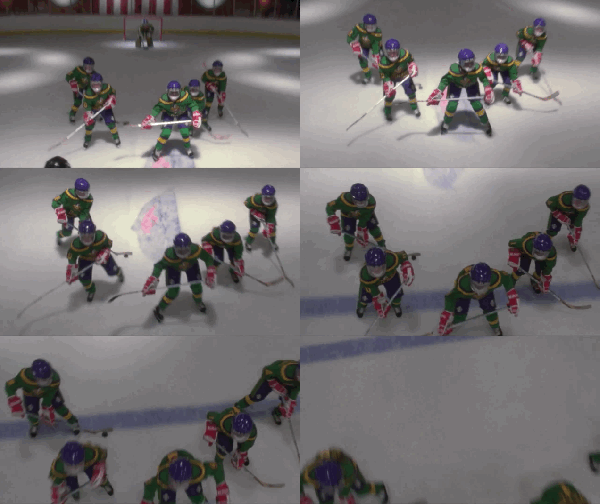
whether you’re a goose, a peewee hockey player, or a sister!
  1. One goose leads the formation until it’s tired, and then another goose takes its place. Like geese, we share leadership at all levels throughout the congregation. Early in my formation I heard that “sisters of St. Joseph never do anything alone.” It’s true! From pitching in (without being asked) to clean up after a meeting, volunteering for committees and events, and leading projects and ministries on local and national stages, I watch my community naturally and seamlessly fill in the gaps to make incredible things happen.

giphy-10

We share the load as a family!

These days, I view geese in a much more positive and loving way, and laughingly think of myself as in touch with my “inner goose!” And when I see a beautiful V-formation of wild geese flying and honking in the air, I greet them as brothers and sisters of St. Joseph, joined in a common mission with all of creation.

About the Author
16-judyminear-copy

Sister Judith Minear currently serves as part of the 3-member team for CSJ Ministries as Coordinator for Mission Integration, working with our 26 sponsored ministries. In her free time, she loves drawing zentangles, stalking birds and savoring poetry.